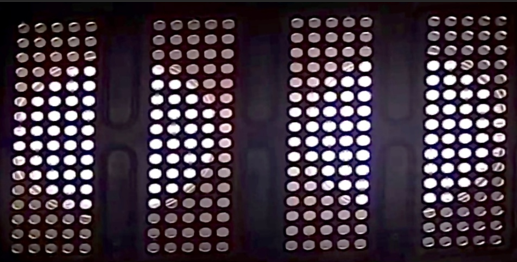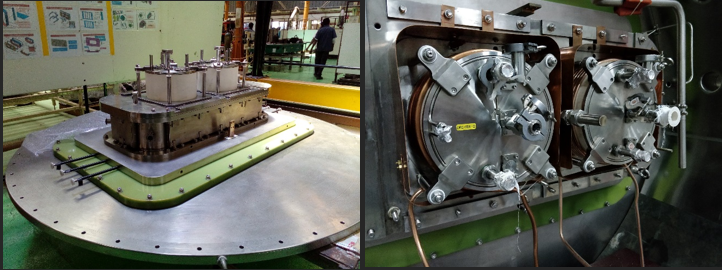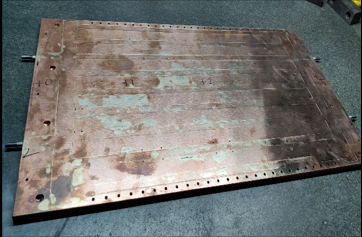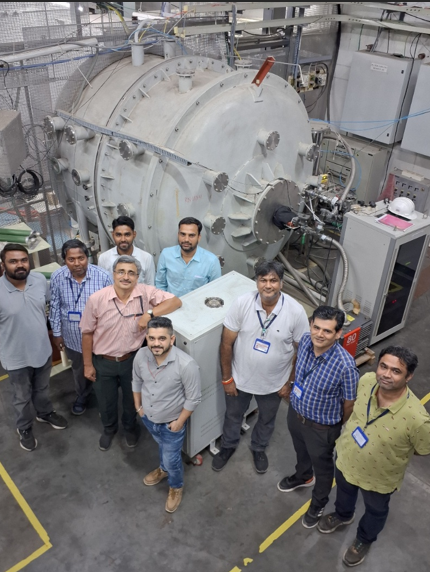

To address operational challenges related to large-size, multi-RF driver, inductively-coupled plasma source, a TWo-driver-based, Indigenously built Negative (TWIN) ion source R&D program has been established in IPR. The prime objective of the TWIN source program is to manufacture a large size, fusion grade, high-power ion source indigenously. In addition, the ion source will be used as the plasma load to test the functionality of IPR’s indigenously developed 1MHz solid-state RF generators before they are hooked to the ITER-DNB ion source. The TWIN source experiments are planned in two phases: (1) Plasma production phase, (2) Negative ion beam extraction phase.
Presently, the hydrogen plasma is produced in both the RF-drivers of the TWIN source simultaneously using an 180 kW, 1 MHz tetrode tube-based RF Generator. The TWIN source can be operated either by keeping the RF-drivers antenna coils and the impedance matching unit exposed to the atmospheric pressure (Air mode operation) or by keeping the coils immersed inside vacuum (vacuum mode operation). Air mode operation is envisaged for low-power, and vacuum mode is for high-power operation. TWIN source body is actively cooled and is designed for a 5-second continuous plasma shot with full 180kW power. So far, 75kW RF power has been coupled to the ion source. Plasma density > 5e17 m^3 is observed in the expansion chamber of the ion source volume, around 20 cm away from the RF drivers. TWIN source is also being used to test the indigenously developed 40 kW solid-state RF generators (SSRFG). Soon, a 200kW solid-state RF generator, to be used for ITER-DNB at INTF, will be connected.