1.Lead Lithium Magneto-Hydrodynamics
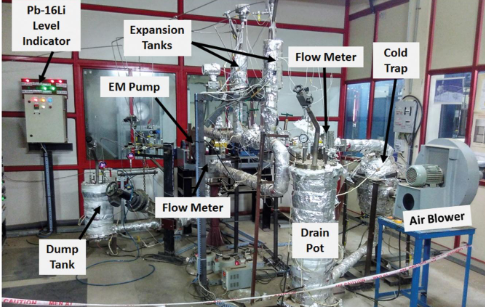
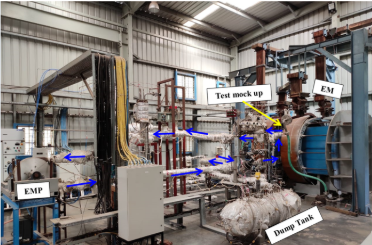
The liquid Lead Lithium Magnetohydrodynamics (LLMHD) experimental facility has been developed at IPR, to facilitate blanket relevant R&D MHD experiments associated with the flow of Pb-Li (at ~ 300°C) under transverse magnetic field. The facility features an electromagnet with a large pole volume (370 mm × 400 mm × 1000 mm), enabling integration of various MHD test mock ups relevant to the liquid breeder blanket flow configurations to generate the MHD database. A series of MHD experiments are performed with different flow geometries under magnetic fields up to 1T and Pb-Li flow rates up to 8 kg/s.
2.Pb-16Li heat extraction facility for LLMHD
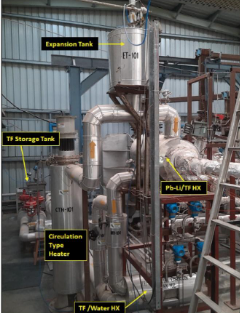
A dual-coolant heat extraction system was designed, developed, and operated for removing heat from molten Pb-Li in a thermo-fluid lead-lithium magnetohydrodynamic (MHD) experiment. The system employs Therminol 55 as the primary coolant to extract heat from Pb-Li through a Pb-Li/thermic fluid heat exchanger, while the absorbed heat is subsequently transferred to demineralized cooling water via a thermic fluid/water heat exchanger. The thermic fluid loop is operated at a flow rate of ~35 lpm in the temperature range of 250–270 °C, whereas the water loop is maintained at ~30 lpm at room temperature. The system successfully extracted a continuous heat load of ~24 kW for ~100 hour duration. Experimental results, including overall heat transfer coefficient, heat duty, and heat exchanger effectiveness, show good agreement with theoretical estimations.
3.Lead Lithium (Pb-16Li) Production System
A Pb-Li production facility with a capacity of ~75 kg per batch has been developed at Institute for Plasma Research (IPR). Pb-Li ingots were produced in an indigenously developed production system based on magnetohydrodynamic (MHD) stirring technique. The produced ingots were characterized analytically and microstructurally to evaluate their composition and homogeneity. ICP-OES analysis confirmed a lithium concentration of 0.59 ± 0.04 wt%, indicating the formation of eutectic Pb-16Li. Further confirmation was obtained through Differential Scanning Calorimetry (DSC) and solidification curve analysis, which showed a melting temperature in the range of 235–238 °C, consistent with the reported eutectic temperature of Pb-16Li (~235 °C). Using this facility, a total of ~750 kg of Pb-Li ingots have been produced which are currently being utilized as process fluid in various experimental systems at IPR.
4.Pb-16Li Purification
As part of the development and testing of a Pb-Li purification system at IPR, a wire-mesh-packed prototype cold trap (CT) was designed, fabricated, and integrated into a purification loop for impurity removal from ~260 kg of Pb-Li. The CT was operated continuously for ~3500 hours (~5 months) in a molten Pb-Li environment to evaluate its long-term functionality and reliability under fusion-relevant operating conditions, where frequent replacement is impractical. During the experiment, the impurity generator was successfully tested, and corrosion impurities were deposited on the CT wire-mesh packing. The performance of the CT was assessed through efficiency estimation. Oxide deposits were also observed inside the CT. Samples collected from the CT were characterized using SEM-EDX, XRD, and ICP-AES techniques. The characterization results indicated the formation of iron–nickel intermetallic needle-like deposits, while the oxide deposits were identified as Pb₂O, Li₂O, and PbO
5.Diagnostics development and qualification for high temperature liquid metals
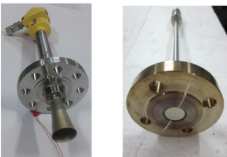
Various diagnostics tools like flowmeters, pressure sensors, level sensors etc. are being developed and/or being qualified for high temperature (300°C-400°C) liquid metal applications. Several precision flowmeters have been designed, fabricated and calibrated at high operational temperatures based up on Faraday’s law of induction. Specially designed flush face pressure transmitters have been qualified for accurate pressure measurement. They have a thin membrane in contact with the hot fluid, behind which an intermediate liquid transfers the pressure to the strain gauge at low temperature to produce the measurable signal. Radar level sensors have been applied and verified to be compatible with high temperature liquid metal. It sends a radio wave to the surface of the liquid and records the transit time to detect the level from the reflected signal from the liquid surface.
6.Absolute Flowmeter Calibration Set-Up for High Temperature Liquid Metals
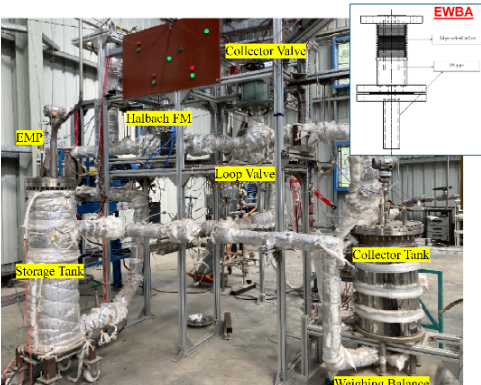
A flowmeter has been designed using Halbach magnet arrangement that provides high sensitivity. The flowmeter is calibrated in a novel high temperature experimental set up using first principles. In the experiment, the mass of molten Pb-Li (at 300°C-310°C) transferred through the flowmeter per unit time has been measured and this information is used to calibrate the flowmeter against the voltage signal obtained in the flowmeter. Accurate Pb-Li mass measurement is made possible by using a novel design of EWBA (Edge Welded Bellow Assembly). The dry calibration has been performed using numerical MHD computations and compared with experimental results.
7.Simulation Capabilities for Liquid Metal magnetohydrodynamic (MHD) effects
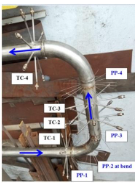
Advanced numerical simulation capabilities have been developed to study liquid metal flows under strong magnetic fields and the resulting MHD phenomena. These capabilities have been utilized for design of various MHD test mock-ups, development of electromagnetic flowmeters, electromagnetic pumps etc. Simulation results have been systematically validated against experimental data. Some examples are (A) capturing reduction in pressure developed by an Annular Linear Induction Pump due to reverse flow formation at pump exit. (B) Numerical capture of Quasi-2-Dimension turbulence velocity profile showing eddies restricted near the walls for liquid metal flow under transverse magnetic field and vertical heat flux against gravity. (C) MHD simulation results for a circular U bend mockup showing distribution of wall electric potential difference.